
10.5.26
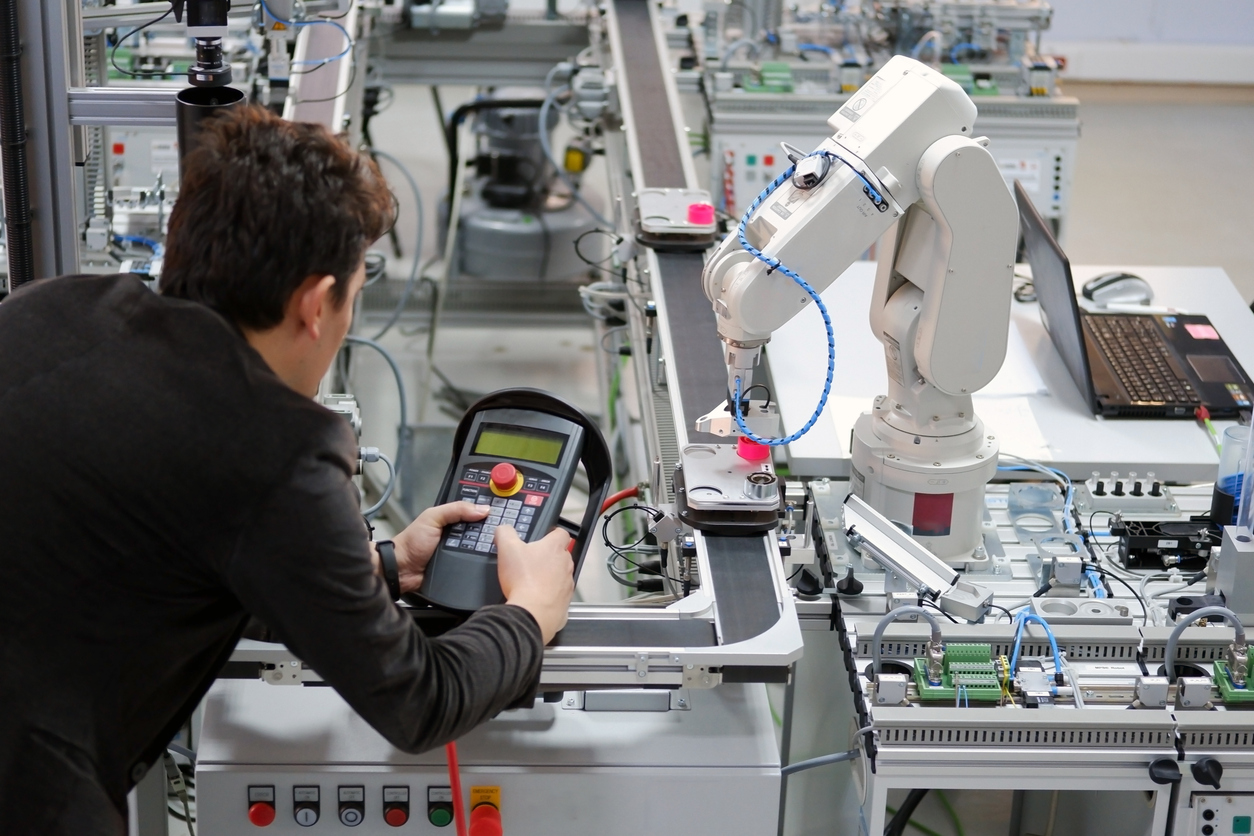
The manufacturing, automation and robotics industry is entering one of its most significant periods of change in decades. Artificial intelligence (AI), advanced robotics, shifting supply chains, tariffs, labor shortages and new production technologies are transforming factories worldwide. At the same time, manufacturers are reconsidering where products should be made and how much human labor future factories will require.
The scale of the industry is enormous. Worldwide manufacturing value added totaled an estimated $16.83 trillion in 2024. Yet the nature of that manufacturing is changing rapidly as companies invest in robotics and automation to increase productivity, improve quality and respond to shortages of skilled workers. The worldwide installed base of operational industrial robots was expected to reach approximately 5.9 million by the end of 2025.
Even more information on this industry is available! Check out our Manufacturing Industry Center.
Plunkett’s Manufacturing, Automation & Robotics Industry eBook, latest edition.
1. AI Is Transforming Factory Automation
One of the biggest trends is the convergence of AI, machine learning and robotics. Industrial robots have been used for decades for welding, painting, assembly and materials handling. However, AI is making robots more capable, adaptable and autonomous. AI-enabled systems can analyze production data, detect quality problems, optimize workflows and help predict when machinery needs maintenance.
Factories are also becoming increasingly connected. Computer-aided design and manufacturing systems can link product development directly to computer-controlled production equipment, while robots can manage warehouses and deliver components to production lines as needed. This combination of software, AI, sensors and robotics is creating increasingly sophisticated smart factories.
Importantly, automation is no longer simply about replacing employees. Manufacturers increasingly need robots to achieve productivity gains while coping with rising wages and shortages of available workers. This means manufacturing output may grow substantially faster than manufacturing employment. The U.S., for example, employed approximately 12.7 million manufacturing workers as of mid-2026, compared with 19.1 million in 1980.
2. Cobots Expand the Reach of Robotics
Another important development is the rapid adoption of collaborative robots, or cobots. These machines are designed to work alongside people rather than being separated from them by cages or other barriers. Cobots tend to be flexible and relatively easy to program, making automation practical for a broader range of manufacturing and warehouse operations.
The potential productivity gains are significant. Data center infrastructure manufacturer Tate operates 58 Hirebotics Cobot Welder systems that achieved a 12-fold increase in output per welder. Sanofi has deployed Universal Robots cobots for end-of-line packaging, cutting working time by 10% while allowing production lines to operate with fewer manual workers.
Robots are likewise spreading throughout warehouses and logistics operations. Automated systems can retrieve products, transport materials and help fulfill orders, making robotics an increasingly important component of the entire supply chain rather than simply the factory floor.
3. Humanoid Robots Emerge as the Next Frontier
Perhaps no development is generating more attention than the humanoid robot. These machines have legs, arms and hands that enable them to operate in environments originally designed for humans. AI-powered humanoids eventually could perform a wide variety of manufacturing, logistics and warehouse tasks without factories having to be redesigned around conventional fixed robots.
China has established a particularly strong position in this emerging industry. Its advantages include extensive government support, enormous manufacturing capacity and an existing supply network for motors, gears, sensors, batteries and precision components. According to data cited in the chapter, Chinese manufacturers accounted for the majority of approximately 13,000 humanoid robots shipped globally in 2025. China is home to dozens of companies developing humanoids, including AgiBot, Unitree and UBTech.
Automotive manufacturers are becoming important testing grounds. BMW, Hyundai, Toyota and Mercedes-Benz are among companies testing humanoids for moving parts, transporting heavy loads and assisting with assembly. Airbus ordered UBTech’s Walker S2 for manufacturing applications in early 2026.
China’s advantage extends to conventional automation. By 2026, China was producing approximately 50% of newly installed industrial robots worldwide and had reached a robot density of 470 units per 10,000 workers. Automation is particularly important because China’s working-age population is shrinking while factory wages have increased.
4. Manufacturing Supply Chains Are Being Reconfigured
Globalization is not ending, but manufacturing supply chains are becoming more diversified. Rising Chinese wages, geopolitical tensions and the supply-chain disruptions experienced during the pandemic convinced many multinational companies that relying too heavily on one manufacturing country creates substantial risks.
As a result, Vietnam, India, Bangladesh and other lower-cost nations are attracting production. China’s share of U.S. imports dropped from nearly 22% in 2016 to about 9% in 2025. At the same time, Chinese manufacturers themselves are moving toward higher-value products, including industrial robots, semiconductor equipment and sophisticated machinery.
Mexico is another major beneficiary. Its proximity to the U.S., transportation infrastructure and trade relationship with the U.S. and Canada make it attractive for nearshoring, in which manufacturers locate production closer to their primary customers.
Reshoring is also bringing some production back to the United States. Approximately 244,000 jobs were reshored in 2025, according to figures cited in the chapter. Lower relative U.S. energy costs, improved productivity and increasingly cost-effective automation can make domestic production more competitive. John Deere expanded excavator production in North Carolina in 2026, while Caterpillar and GE Aerospace have been expanding U.S. manufacturing capacity and local supply chains.
5. Tariffs Create New Costs and Uncertainty
Tariffs are simultaneously encouraging companies to reconsider overseas sourcing and creating significant challenges for manufacturers. Duties on imported materials and components can raise production costs, disrupt established supply chains and force manufacturers either to absorb additional expenses or pass them to customers.
The uncertainty itself can be consequential. Some companies are delaying production and capital-investment decisions while waiting for greater clarity about tariff policies. Despite increased tariffs, the Kearney Reshoring Index remained negative in 2025, illustrating that bringing manufacturing home is more complicated than simply raising the cost of imports.
6. The Future
Technologies such as 3-D printing, advanced software, high-speed networks and additive manufacturing are reinforcing the transformation. 3-D printing can dramatically reduce prototyping and product-development costs, while digital design systems make it possible to move more quickly from an idea to automated production.
The result is a fundamentally different manufacturing landscape. Future competitiveness will increasingly depend on the combination of AI, robotics, skilled engineering talent, resilient supply chains and flexible production. Factories will become more automated and productive, while cobots and humanoids will increasingly work alongside people. Meanwhile, manufacturers will continue balancing the efficiencies of global production against the security of nearshoring and reshoring.
Key Concepts: Manufacturing, factories, robotics, factory automation, auto makers, China, machine tools, additive (3D) manufacturing, OEM – Original Equipment Manufacturing, ODM – Original design manufacturing, artificial intelligence (AI), tariffs, humanoid robots, cobots
Source: Plunkett Research, Ltd., Copyright © 2026

